AI food product video — and photography for menus. From one photo of what you sell.
Food is the category that will not sit still: it melts, wilts, dries out and stops looking like itself somewhere between the second and third take. Nitaris builds the shot from a photo instead — a cinematic film of your product, plus a set of marketing photos for the menu, the delivery-app tile and the feed.
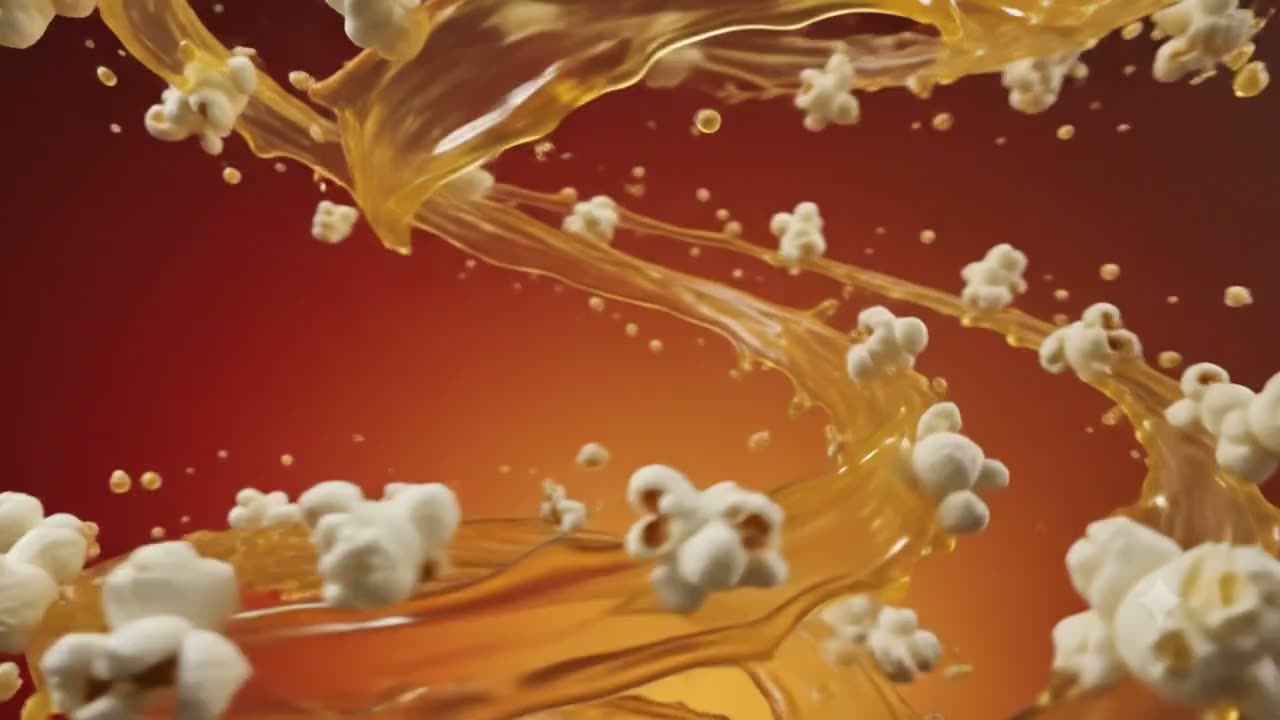
One packshot in. A moving hero shot out.
This is the whole food reel so far: one widescreen film, generated by Nitaris from a single flat photo of a bag of caramel popcorn. It is here on its own rather than tiled six times across a grid, because six copies of one clip is not a portfolio.
Caramel popcorn, mid-air
Widescreen 16:9, sized for a product page, a menu screen or a paid placement as it comes. Popcorn suspended in a swirl of hot caramel — the kind of shot that needs a high-speed rig and a very patient food stylist to capture for real.
It says 0:08, not 0:10
Nitaris’s films run about ten seconds, and this one came out at eight. The badge reports the length of the file you are actually watching, measured off the file itself rather than copied from the brief — so a clip that landed short says so.
It is a small thing, and it is the whole point. This page exists to prove the output is real. A page that will round eight seconds up to ten in the corner of a frame is a page that will exaggerate the rest of it too.
- Every runtime on this site is read from a table of measured lengths, not printed as a constant.
- A clip nobody has measured gets no badge at all rather than inheriting another clip’s number.
Why a food shoot is so expensive
Half of a commercial food shoot is chemistry.
Not because photographers are dishonest, but because real food will not hold a pose for the two hours it takes to light one. Once you know what a studio actually does to make food survive a shoot, generating the frame from a photo stops sounding like a shortcut.
Real food dies on set
Condensation on a cold bottle runs off in seconds, so it gets sprayed on as a glycerine and water mix that holds its droplet shape for weeks. Ice becomes acrylic. Ice cream becomes coloured mashed potato, because potato does not melt under hot lights. Whipped cream becomes shaving cream. The milk in a cereal bowl becomes white glue, so the flakes stay dry through a long shoot.
Gloss is a lighting position, not an ingredient
The sheen on a sauce or a syrup is a property of where the light is standing. Light from behind is what makes liquids, oils and syrups read translucent and puts the specular topnote on them — and it has to be side-behind, roughly 120 to 160 degrees off the lens axis, because a pure 180-degree backlight leaves no readable light on the front of the plate at all.
Steam does not exist unless it is backlit
Steam reads only against a dark background, and only when the light comes from behind or side-behind it. Anywhere else it is invisible. Which is why the steam in the advert is usually not steam: it is damp cotton wool, microwaved and hidden behind the plate, because vapour off actual hot food is gone before the second take.
Texture comes from the angle, not the amount
What makes a surface look like something you want to eat is raking light — a source at a very shallow angle across it. Overhead is the angle for pattern and structure; black cards flanking a top light deepen the shadows that let texture read at all. Softness is only source size divided by distance, so the same big light moved back becomes a hard one.
A bag, a bottle and a can are three different lighting problems.
Most food and drink brands are not selling a plated dish — they are selling a printed surface that has to stay legible while also looking good. Those two goals pull against each other, and every rule below is one studios use to reconcile them.
- Cans and foil get tented. Soft, even illumination all the way round, because on a reflective pack a hot spot lands straight on the artwork and takes the branding out of the frame with it.
- Bottles get lit from behind. Backlight so the light passes through and shows the liquid’s real colour and clarity, front fill so the label stays readable, and black cards at the sides to draw a defining edge down the glass.
- Labels sit square to the lens, not raked away from it — and a drink is shot at eye level, on the liquid line, so the surface reads as a straight line rather than an ellipse and the vessel keeps its silhouette.
- Colour has to be accurate, not just pretty. Whenever the packaging is the point, the reference standard is the pack matching its own brand colour, which is a different job from a mood grade.
And the one to actually watch for: printed text is the largest single failure mode in generated product imagery. A piece with no writing on it is the easiest thing in the world to shoot; a snack bag covered in copy is the hardest. So read the pack in every frame that comes back — the name, the weight, the flavour, the small print — and regenerate any take where a character has drifted. Nitaris conditions every frame on your own photo and is built to hold your logo and label true, and regenerating is one click — same product, same brief, a fresh take. But check it before you post it.
One reference photo, sized for every place people order from you.
A food business does not have one shop window any more. It has a menu, a delivery-app listing, a website, and a feed that wants motion — and the same dish has to look like itself in all four. One reference photo, and a render composed for each shape rather than cropped to it.
- Widescreen 16:9 for your site, a menu screen, or a paid placement — delivered as a clean MP4.
- Vertical 9:16 for Reels and TikTok, where a food shot in motion does the work no still can.
- Stills in 1:1, 3:4 or 9:16, three to six per set — square for a delivery-app tile and a grid, portrait for a printed or digital menu.
- Full commercial rights to every video and photo, no watermark on paid files, and no subscription — a one-off $9 Try pack, then credit packs from $24 for five films.
Your first film is a free watermarked preview of your own product, so you can see it on the thing you actually sell before you spend anything.
Other categories
Every material photographs differently.
What makes a category hard to shoot is specific to the material — so the approach is too.
Jewellery
Metal that reflects the whole room and stones that only sparkle under moving light.
Watches
The 10:10 convention, a legible dial, and a crystal that has to catch light without blowing out.
Where you sell
Built for the placement, not just the file.
Same shoot, sized and framed for the surface it has to land on.
Shopify
Runs inside your admin — pick a product, generate, attach to the listing without leaving the page.
Etsy
One-off pieces you have already shipped — the listing photo is enough to film them.
WooCommerce
No plugin to install — generate in the browser and upload the files to your product like any other media.
Reels & TikTok
Vertical 9:16, composed for the sound-off feed, with 4:5 and square cuts from the same film.
Still choosing a tool
Honest comparisons, including where they win.
Every one of these names something the other tool does better than Nitaris. If that is the thing you need, go and use it.
Nitaris vs Creatify
an AI ad-creative platform built around UGC-style video with presenters
Nitaris vs Photoroom
a large image-editing suite built around background removal and product stills
Nitaris vs soona
a managed content studio — you ship real products and receive photography and video shot by people
Nitaris vs Pebblely
an AI product-photography tool focused on placing products into generated backgrounds
Nitaris vs Runway
a general-purpose generative video platform — a creative suite for making video, images and audio of anything
Nitaris vs HeyGen
an AI video platform built around lifelike avatars that deliver a script, with translation and lip-sync across languages
Nitaris vs Arcads
an AI ad platform built around a large library of AI actors delivering ad scripts for performance marketing
Nobody orders from a flat photo. Make it move.
Send the packshot you already have and see it filmed — free, watermarked, and of your own product.
Last updated