AI watch photography, and a product video of the same watch. From one photo on your bench.
A watch is a case, a bezel, a crystal and a bracelet — four different surfaces, three of them mirrors. Nitaris takes the flat photo you already have and returns a film that moves across all four, plus a set of marketing photos of the same piece.
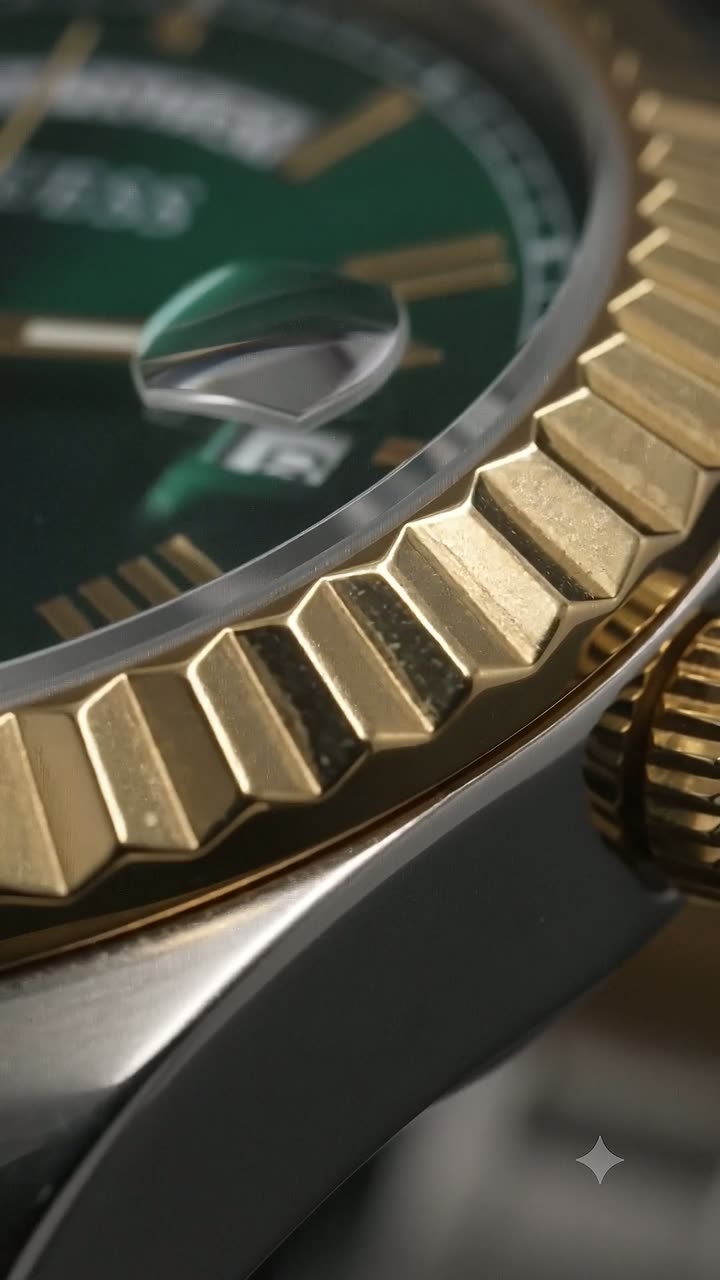
One watch, one film, generated from one photo.
This is the whole watch reel so far: a single film of a two-tone steel and gold wristwatch. It is here rather than a grid of nine variations of it, because nine variations of one clip is not a portfolio. The runtime in the corner is the file’s measured length.
Two-tone, in motion
Focus racks across the fluted gold bezel, the green dial, the cyclops date lens and the polished case flank — vertical, sized for Reels and TikTok as it comes.
Four surfaces, four problems
A watch film is not one shot held for ten seconds. It is a move between the four things a buyer inspects — and each of them fails in a different way.
- The fluted bezel. Each flute is a separate mirror facing a slightly different direction, so a bezel either reads as a ring of individual bright edges or as one dead gold band. It is the first thing that tells a buyer whether the photograph was lit or just taken.
- The green dial and its markers. A coloured dial under a flat, even source goes muddy and the applied markers blow out. The luxury look is a gentle gradient across the crystal from a large source held at the very edge of the reflection — a hint of sweep, not a dead-black disc.
- The cyclops and the date window. A domed magnifier over a date window is a lens sitting on top of a mirror. Some reflection in it is correct — it is what describes the curve — but it has to stay balanced against the date staying legible underneath.
- The case flank, lug and crown. A polished flank next to a brushed one is a transition you can only see if the light falls off across it. Flat-on, the whole case goes soft and round — the reason watch photographers shoot from above the wrist plane rather than square to the dial.
Why watch photography goes wrong
Three of the four surfaces on a watch are mirrors.
Which means you are not lighting the watch. You are lighting the reflection the watch shows — and on a polished case, the camera and the room are inside that reflection. This is what Nitaris is directing around.
The camera prints itself into the case
On any front-facing polished surface, the lens is inside the cone of angles that bounces light back to it — so it appears as a black hole in the metal. Distance and a long lens are what pull it out of that cone, which is why luxury product work is shot from further away than the framing needs.
Two-tone is two colour temperatures on one object
Steel and white metal want cool light, 5500 to 6000K, to read crisp and bright. Gold wants the opposite — warm, around 3000K — or its own colour washes out toward pale brass. Most categories get to pick one. A two-tone case needs both at once, on the same bezel, in the same frame, which is why so many watch photos have either grey gold or orange steel in them.
A blown highlight turns gold into silver
Retaining the specular highlight is the whole discipline here: a clipped one is pure white with no colour in it, so gold reads as silver and silver reads as paper. It is also why over-sharpening ruins a watch — it destroys the smooth gradients that make polished metal look polished.
Flat-on flattens the whole case
Shot square to the dial, a watch loses its flank, its lugs and its depth — the “pizza effect”. The angle that works sits 20 to 40 degrees above the plane of the wrist, close enough that the lugs still read against the wrist without overhanging it.
Every watch in every advert reads about ten past ten.
It is a convention with a reason. Through to the 1950s the standard was 8:20, which was symmetrical but hung both hands downward and covered the maker’s name at the bottom of the dial. 10:10 inverts it: the V opens upward, frames the logo at twelve without ever crossing it, leaves sub-dials and the date window clear — and reads to the eye as a smile. A study in Frontiers in Psychology found watches set to 10:10 produced a measurable positive effect on the viewer and on their intention to buy, against 11:30 as the neutral control. Some houses use 10:08. Some deliberately break it — 5:32 is a legitimate choice if it uncovers something worth seeing.
Which matters here for a practical reason: Nitaris conditions every frame on the photo you give it. The dial in your reference is the dial in your film. So set the hands, wind the crown, blow the dust off the crystal — before you take the photo you upload. It is thirty seconds of work that no amount of generating can put back afterwards.
- Set the time before you shoot the reference — 10:10, or whatever your brand uses.
- Clean the crystal and the case. Dust and fingerprints on a mirror are the top failure mode in watch photography, and they are in the reference before they are in the film.
- If you shoot it on a wrist, roll the cuff down to the watch and take the other bracelets off — anything else on the wrist competes with the piece.
- Give it a photo taken from slightly above the wrist plane rather than square-on, so the case has a flank in it to begin with.
A film for the feed, and photos for the listing.
A product page needs stills and the feed needs motion, and shooting them separately is two briefs that never quite match. Credits cover both — eight for a film, one per photo — from the same reference photo, so they do match.
- A cinematic film, delivered as a clean MP4: vertical 9:16 for Reels and TikTok, or widescreen 16:9 for your product page and ads.
- A set of marketing photos in square 1:1, portrait 3:4 or vertical 9:16 — three to six shots per set.
- Your first film is a free watermarked preview of your own watch. Unlocking the clean master costs what generating it would, with no re-render and no wait.
- Full commercial rights to everything you make, and no watermark on paid files. No subscription — a one-off $9 Try pack, then credit packs from $24 for five films.
Other categories
Every material photographs differently.
What makes a category hard to shoot is specific to the material — so the approach is too.
Jewellery
Metal that reflects the whole room and stones that only sparkle under moving light.
Food & drink
Steam, condensation and gloss — the cues that read as fresh, and go stale within minutes on a real set.
Where you sell
Built for the placement, not just the file.
Same shoot, sized and framed for the surface it has to land on.
Shopify
Runs inside your admin — pick a product, generate, attach to the listing without leaving the page.
Etsy
One-off pieces you have already shipped — the listing photo is enough to film them.
WooCommerce
No plugin to install — generate in the browser and upload the files to your product like any other media.
Reels & TikTok
Vertical 9:16, composed for the sound-off feed, with 4:5 and square cuts from the same film.
Still choosing a tool
Honest comparisons, including where they win.
Every one of these names something the other tool does better than Nitaris. If that is the thing you need, go and use it.
Nitaris vs Creatify
an AI ad-creative platform built around UGC-style video with presenters
Nitaris vs Photoroom
a large image-editing suite built around background removal and product stills
Nitaris vs soona
a managed content studio — you ship real products and receive photography and video shot by people
Nitaris vs Pebblely
an AI product-photography tool focused on placing products into generated backgrounds
Nitaris vs Runway
a general-purpose generative video platform — a creative suite for making video, images and audio of anything
Nitaris vs HeyGen
an AI video platform built around lifelike avatars that deliver a script, with translation and lip-sync across languages
Nitaris vs Arcads
an AI ad platform built around a large library of AI actors delivering ad scripts for performance marketing
A watch is bought on a close-up. Give it one that moves.
Send the photo you already have and see the bezel catch the light — free, watermarked, and of your own watch.
Last updated