A product video is a promise the parcel has to keep
Nitaris holds your product true — shape, colour, materials and logo stay as they are. But the choices that remain yours, the mood and the set and the quality of the light, quietly state a price. A buyer prices the object from the film, then opens the parcel. When the film promises more than the parcel delivers, the sale you won becomes a return.
Published — written and checked by hand.
There is a moment, a few days after the order, when somebody who has only ever seen your product on a screen holds it for the first time. Everything you published is being marked against the object in their hand. That is when a product film is finally judged, and it happens a long way from the moment that made you feel good about it.
It is worth thinking about before you choose a mood, because it is the one consequence of that choice that nothing warns you about.
Two halves, and only one of them is automatic
A shoot has two parts. The first is the description. Every frame is conditioned on the photo you upload, so the shape, the colour, the materials and the logo stay as they are. You do not choose that part and you cannot break it — it is the entire reason for uploading a reference at all.
The second part is everything the reference does not fix. Where the object sits. What the light is doing. Whether the camera drifts across a dark set with a single hard highlight travelling over the surface, or sits in flat daylight on a plain sweep. That half is yours, and it is where the trouble lives, because it is not neutral.
A set is a price tag
Look at any category you buy in yourself and you can read the price off the photography before you find the number. Deep shadow, a lot of black, a slow move and one specular highlight tracking across metal: expensive. Bright, even, white, everything visible at once: mid-market and honest about it. Warm daylight, a wooden surface, a slightly imperfect crop: handmade, small-batch, priced on personality rather than materials.
Nobody is taught this and everybody knows it. That is what makes it useful, and it is also the problem: the grammar does not check whether the claim is true. It will make a modest bracelet look like an expensive one, and it will do it convincingly, because the shape and the colour and the finish in that film really are your bracelet's.
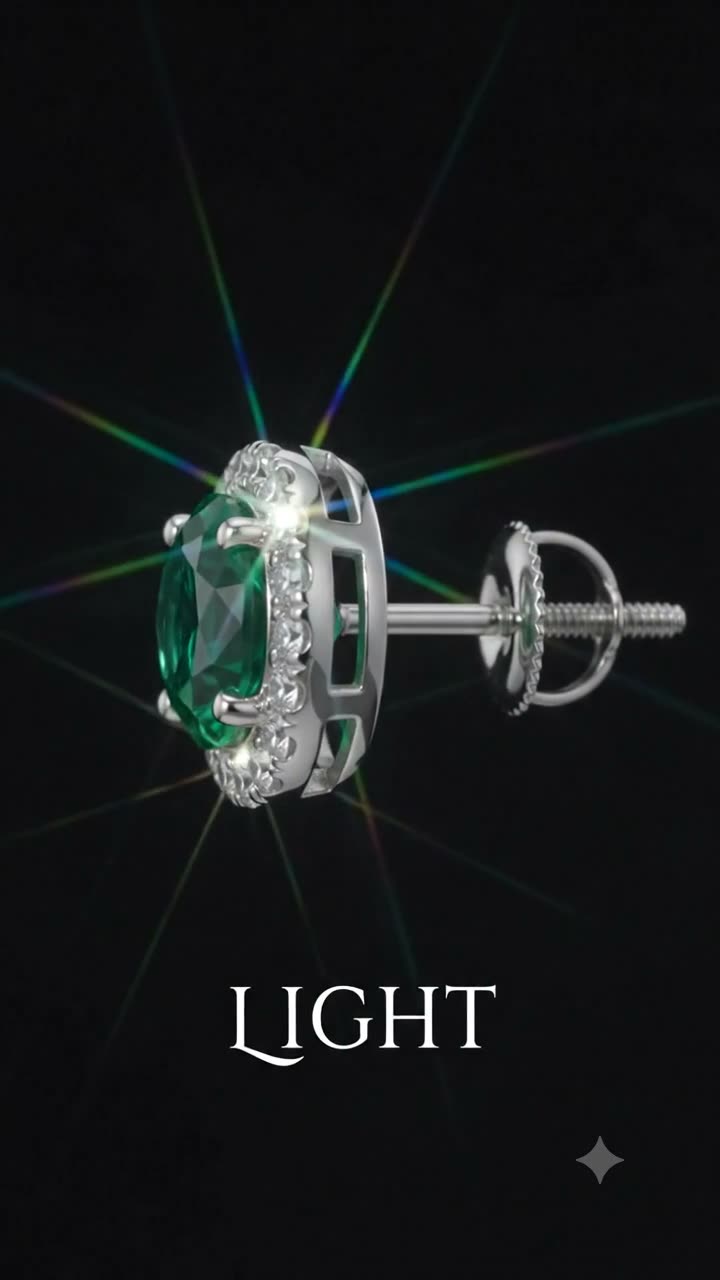
That is a real earring, described accurately. The reason it reads as expensive is not deception — the setting and the stone are what they are. But notice how much of the impression is coming from the black background, the flare and the pace. Put the same object on a white sweep in flat light and it is the same object, described just as truthfully, at a different price.
The test is the parcel, not the post
So the useful question is not whether the film looks good. It will look good; that is what it is for. The question is whether somebody who buys because of this film will feel that the thing which arrives is the thing they saw.
Feel is the right word and it is doing real work. Nobody unpacks a parcel and checks it frame by frame. They take it out of the box and have an immediate, unarguable reaction about what it is worth. If the film set that expectation two tiers above the object, the reaction is disappointment — and disappointment rarely arrives as a complaint. It arrives as a return, a lukewarm review, and a customer who does not come back. Three costs, each of them larger than the sale.
The awkward part is that you are the last person able to spot the gap, because you already know what the object is. You have held it. When you watch the film you see your product plus everything you know about it, and the two cannot be separated. A buyer sees only the film. The nearest thing to a fix is to show it to somebody who has never seen the thing and ask what they would guess it costs. Thirty seconds, and more reliable than an hour of your own staring.
Where the line actually sits
Not every flattering choice is a promise. Only some of them are claims the parcel has to honour:
- Materials are the hard floor. A film can light plated brass beautifully. It should not light it so that it reads as solid gold, because the parcel settles that argument in about four seconds.
- Scale is next. A dramatic macro is honest about surface and silent about size. If your product is smaller than people tend to assume, the shot that flatters it most is the one that hides the fact.
- Weight and finish follow. Deep, moody lighting reads as dense and substantial. A light, hollow object shot that way can arrive feeling cheap even when every detail was described accurately.
- Everything else is yours to play with. Pace, grade, background, angle, how long the camera holds — none of that makes a promise the object has to keep.
Shoot one step below your ceiling, on purpose
The practical version is simple and slightly counterintuitive: pick the mood one step plainer than the most flattering one available to you.
There is a free watermarked preview of your own product before you pay anything, so the cost of checking is a few minutes rather than a budget. Generate the version you want. Then look at it and ask what price it implies, and hold that against the price you actually charge. If the film is asking for more than you are, you have not made a better advertisement — you have made a more expensive product than the one you sell, and the difference gets paid for later, by somebody opening a box.
If a take drifts further than you meant it to, that is what regeneration is for. Another attempt costs a great deal less than one return.
The exception worth naming
There is one case where going bigger is simply right, and it is worth stating so none of this reads as an argument for dull films. If your product genuinely is the expensive thing — the materials are real, the finish is what it looks like, the price matches — then plain lighting is not honesty. It is underselling. A well-made object photographed flatly reads as a worse object than it is, and the whole point of holding the reference true is that you are allowed to shoot your product at the tier it actually occupies.
So the rule is not be modest. It is be accurate — and when you cannot tell which way you are wrong, be wrong in the direction the parcel can survive.
None of this is a limitation of the tool. It is what happens whenever anybody is handed a studio. The studio does not know what your product costs, and it will render whatever you ask for with complete conviction. The judgement about which version is true is the part that stays with you, and it is worth two minutes, because it is the only part of the whole process that gets settled by somebody else, in their kitchen, a week later.
Read enough? Watch your own product.
One photo in — a cinematic 10-second video and a full set of marketing photos out. Your first one is free.