A listing is a sequence, not a gallery
A product listing's images are read in order, not browsed as a gallery. Each slot answers the next question a shopper has — what is it, what is it made of, how big is it, what does it look like in use — and a row that answers the first question six times leaves the other three unanswered.
Published — written and checked by hand.
There is a habit almost every seller has, and it is an understandable one. You get a set of images back from a shoot, you pick your favourite, you put it first — and then you fill the rest of the row with the runners-up. Six frames, all of them the product on a clean background, all of them at roughly the same distance, differing mainly in the angle of the light.
That is a gallery: a set of alternatives, offered so the viewer can choose. But nobody chooses. A shopper moves along the row in order, and stops as soon as they either have what they need or have lost interest. Which means slots two, three and four are not alternatives to slot one. They are the next three things you get to say.
The row is read in order, and it is read fast
Whatever surface you publish on — your own storefront, a marketplace, an ad carousel — the images sit in a sequence you control, and the viewer moves through them the way they would move through sentences. The first image earns the second. The second earns the third. Nothing earns anything by being a slightly better-lit version of what came before it.
This is why the useful question about an image is never 'is this a good photo'. It is 'what does this one add that the one before it did not'. A frame that adds nothing is not neutral — it costs a slot, and it teaches the shopper that scrolling further is not worth it.
Four slots, four questions
The questions a shopper resolves, roughly in this order, and what each one wants from a frame:
- What is it? The hero shot. Product, whole, unambiguous, close to how it will look in a grid. This is the only slot where 'the best-looking photo' is the right test.
- What is it made of? The macro. Close enough to read the finish — the grain of the leather, the setting of a stone, the weave, the seal on a packet. This is where a shopper decides whether it is worth what you are asking.
- How big is it? Scale, settled by something familiar. A hand, a wrist, a table, a person. Stills lose scale more reliably than any other property, and no amount of describing it in the copy repairs a row that never shows it.
- What does it look like in use? The lifestyle frame. The product in the situation the buyer is imagining, with the light and the clutter that situation actually has.
Four questions, four frames, and none of them is a duplicate of another. That is the whole structure. Everything after the fourth slot is either a variation for a shopper who is already convinced, or it is padding.
The same product, framed for different slots
The set Nitaris returns is shaped this way on purpose: a hero listing shot, a macro of the clasp or the stone, a lifestyle frame with props and practical light, and an on-model frame that shows scale. Same reference photo, same art direction, four different jobs.
It is worth seeing what that means concretely. The film below is an emerald halo stud earring worn on the ear — the frame that settles scale and skin tone, and the one a jewellery listing is weakest without.
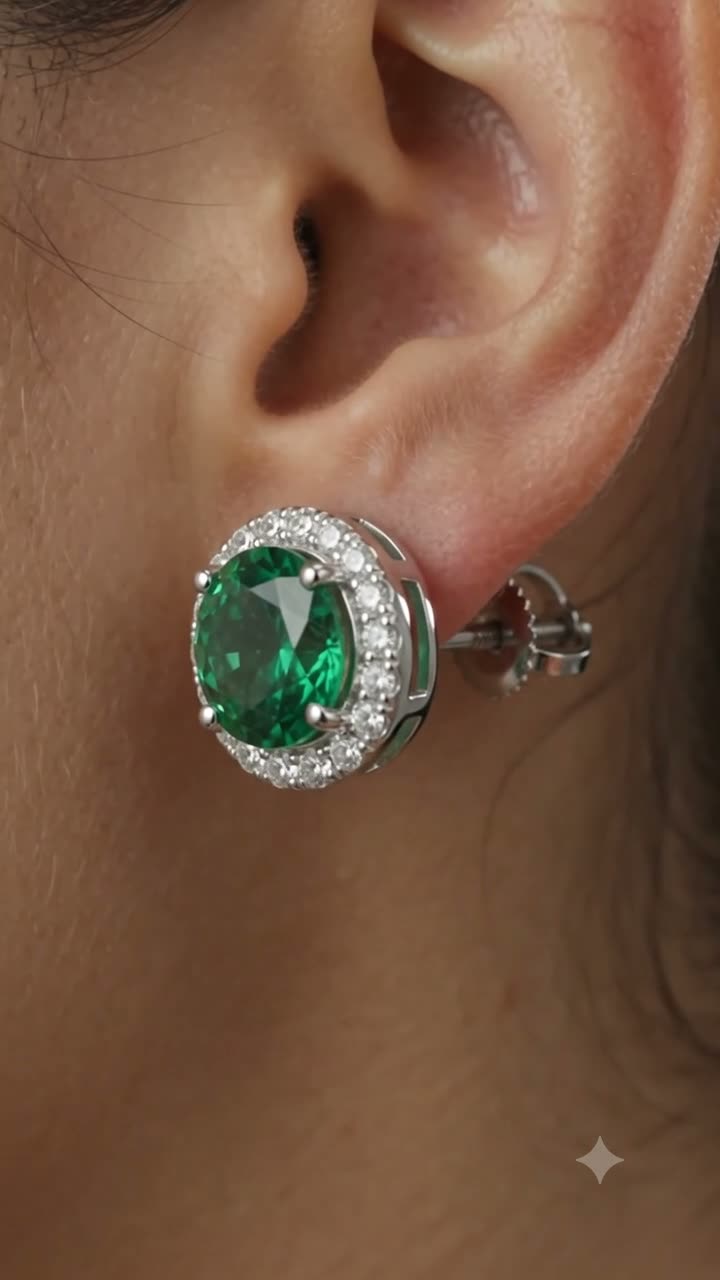
There is a second film of that exact earring in macro, turning through starburst flares on black, and it is a far more striking image. If you had to keep only one you would probably keep the macro. But a row containing only the macro has told a shopper what the stone looks like and left them with no idea how large it is — and 'how large is it' is the question that stops a jewellery purchase. The two frames are not competing. They are slots two and three.
What to do when you have six
Nitaris generates stills in batches of three, four or six. Three maps cleanly onto hero, macro and scale. Six does not map onto anything by itself, and this is where the gallery habit creeps back in — you have six good images, so you post six good images.
A better use of the extra two: cover the shapes rather than the angles. Photo sets render square 1:1, portrait 3:4 or vertical 9:16, and those are not stylistic choices, they are different placements. The square is the listing grid. The portrait gives the product room in a feed. The vertical is a full-bleed still for a story or a paid placement. Two of your six spent on a different ratio of a frame you already have is worth more than two more angles of the hero, because it means you are not letting somebody else's crop decide what is in shot.
Where the video goes
A ten-second film is not a fifth question. It is the whole sequence, compressed, for the shopper who would rather watch than scroll — which is why it works better as the second item in a row than as the first. The first slot has one job, and that job is being legible as a still at thumbnail size. A video placed there is judged on its opening frame anyway, which is a separate argument and one worth reading before you keep a render.
The film also does something the stills cannot: it shows the product moving, which resolves the material questions faster than a macro does. Light travelling across a surface tells you whether something is matte or glossy in about half a second. So a row with a film in slot two can often afford to spend slot three on scale and slot four on the lifestyle frame, and skip the separate macro entirely.
The test, before you upload anything
Lay the set out in the order you intend to publish it, and read it as a list of statements. If two frames make the same statement, one of them is not earning its slot — replace it with the missing question rather than with a better version of the one already answered.
This costs nothing. It is not a shooting decision, a budget decision or a tooling decision; it is a decision about order, made after the images already exist. Which makes it the cheapest improvement available on a listing, and the one most consistently skipped, because a set of six good photographs looks finished in a way that a set of six good photographs in no particular order is not.
Read enough? Watch your own product.
One photo in — a cinematic 10-second video and a full set of marketing photos out. Your first one is free.