A photo does not tell you how big your product is
The photo you upload settles what your product looks like. It does not settle how big it is: a photograph on white contains no ruler. Everything a film adds afterwards — the ground, the falloff of the light, the depth of field, the speed of the camera — implies a size, and getting that wrong is the failure people feel but cannot name.
Published — written and checked by hand.
Ask somebody why a product shot looks off and you will usually get an answer about the lighting, or the background, or a vague sense that it looks fake. Occasionally that is right. Often what they have actually noticed is that the thing in the frame appears to be the wrong size, and they have no vocabulary for that, so it comes out as generalised distrust.
It is worth separating this from the objection it gets confused with. Whether a generated film keeps your product's shape, colour, materials and logo is a question about fidelity, and it has a clear answer: all four are present in the photo, so all four are things a shoot conditioned on that photo can hold. Size is different in kind. It is not in the photo to be held.
A photograph on white has no ruler in it
Photograph a signet ring on white, cropped tight. Photograph a napkin ring the same way. If both are well shot, the two files are close to indistinguishable, and no amount of looking at either one will tell you which is which. That is not a flaw in the photos — it is what a cutout on a plain ground is: a record of shape, colour and finish with every scale cue deliberately removed.
For a listing thumbnail that is usually fine, because the page carries the dimensions in text a few lines below. A film has no text a few lines below. It has ten seconds of moving image, and moving image is unusually loaded with size information whether you intend it to be or not.
What implies size in a moving frame
None of these is a setting you tick. They are properties every frame has, and each one is a statement about how big the subject is:
- Depth of field. Focus that falls away within a few millimetres reads as macro, which reads as small. The same subject held sharp front to back reads as something you would pick up with two hands. This is the strongest cue and the easiest to get wrong.
- The ground. A weave, a grain, a stone speckle, a droplet — every ground has its own texture at its own physical size, and the ratio between that texture and your product is a direct measurement. A linen slub beside a watch states the watch's diameter whether you wanted it stated or not.
- How the light falls away. Light drops off across a small object almost not at all, and across a large one visibly. A gradient rolling down the side of a bottle says the bottle is big; a surface lit flat and evenly says it is not.
- Camera speed. How much of the frame the subject crosses per second is a function of how far the camera is from it, which is a function of how big it is. A drift around something tiny and a drift around something enormous are the same shot at different distances, and the speed is what separates them.
- Particles. Droplets, dust, crumbs, splashes. These have real-world sizes people know without thinking, so a splash scaled for a mug beside something you meant to be a lipstick reads as wrong before anyone works out why.
A generated shoot has to commit to all five, and it commits from a photo that specifies none of them. What it produces will be plausible. Plausible is not the same as correct, and the gap between them is where scale errors live.
The earring is the worked example
This site publishes the same emerald stud earring twice, and the pair is worth looking at because the second film exists for exactly this reason.
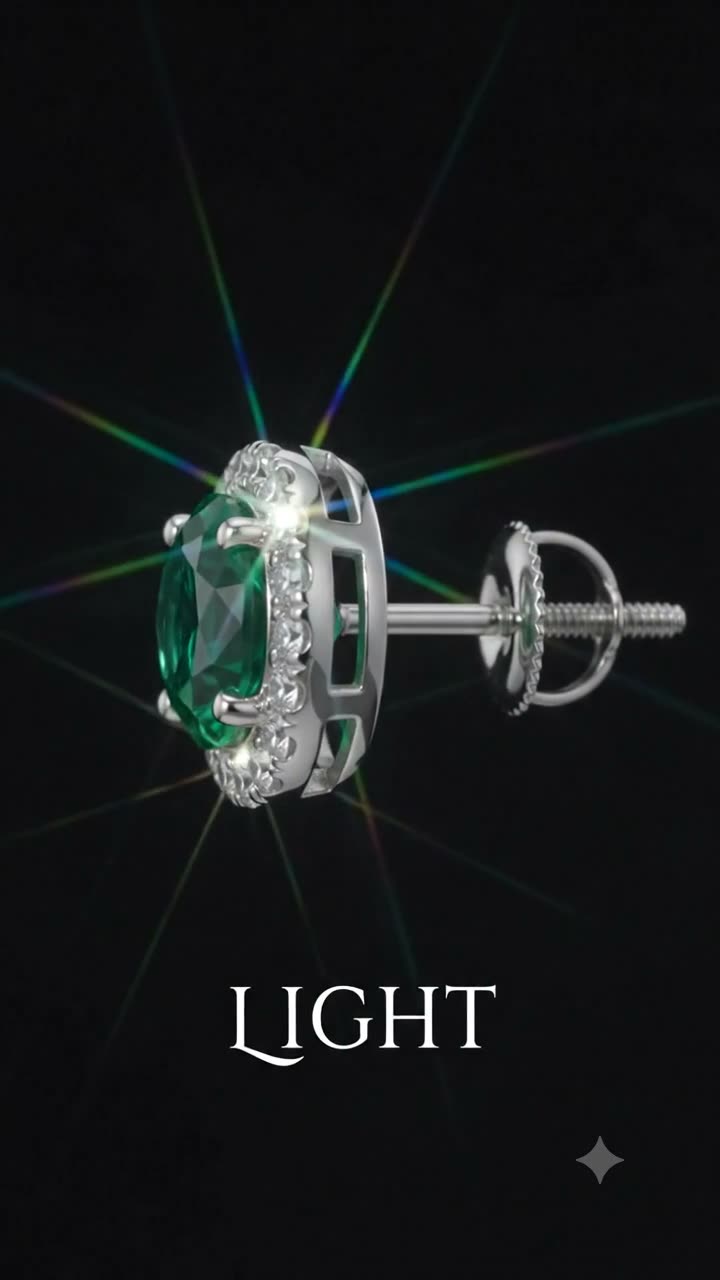
That is the macro: black ground, hard specular light, starburst flares breaking across the stone as it turns. It is a good film, and it is almost silent on the question of size. The flares and the shallow focus say small, roughly — but roughly is all you get, because the frame contains nothing whose size you already know.
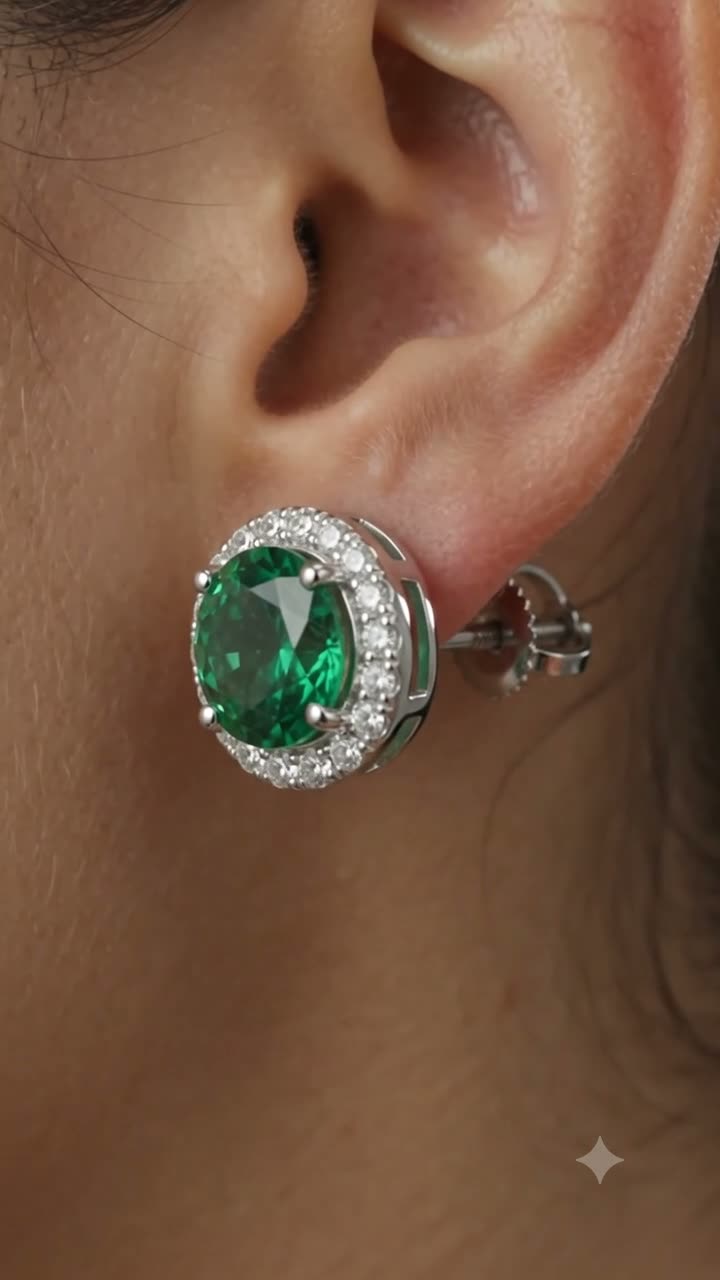
Same earring, worn on an ear in soft daylight. The film is less dramatic and it answers a question the macro cannot, because an ear is a ruler everybody owns. There is no ambiguity left about how big the stone is. That is not a stylistic preference between two takes; it is one take carrying a piece of information the other does not.
Jewellery makes this vivid because the range of plausible sizes is wide and the consequence of guessing wrong is a return. The same problem sits under cosmetics, candles, supplements, hardware, miniatures, and any packaging photographed on its own. If a category's products are frequently described as smaller than expected, that category has a scale problem, and its video has it too.
Why this bites harder in video than in stills
Two reasons, pulling the same direction.
The first is that a film contains more scale cues than a still. A still commits to depth of field and to a ground. A film commits to those, and to motion, and to falloff over time, and to whatever moves through the frame. More cues means more surface area for one of them to contradict the others — and cues that disagree with each other are the specific thing that reads as artificial, more reliably than any single cue being wrong.
The second is that people watch films with less deliberation than they read product pages. Nobody pauses a ten-second clip to work out the implied focal length. They form an impression and move on, and if the impression is that something is not quite right, they do not investigate. They believe the seller slightly less, and you never find out that it happened.
What to do about it
Four things, in the order of what they cost you:
- Check scale first when you review a take — before the finish, before the background, before whether you like it. Ask what size this object appears to be, then ask whether that is its size. It takes a second, and it is the check most likely to catch a film you should not publish.
- Give the source photo a scale cue when the product is scale-ambiguous. A hand, a surface with known texture, an everyday object in shot. You lose the clean cutout and you gain a frame with the answer already in it.
- Plan at least one framing in the row that settles it: worn, held, in use, or beside something. It does not have to be the hero. It has to exist, so a shopper who is unsure can resolve the question without leaving the page.
- Regenerate when a take has the size wrong, rather than living with it. That is not a fault you fix by adjusting the copy underneath.
The honest costs
Two, and neither is small enough to leave out.
A scale cue in the source photo is a constraint on every frame generated from it. The hand or the surface you added is now part of the evidence the shoot works from, and you have traded compositional freedom for certainty about size. For a product nobody misjudges — most homeware, most apparel, anything whose size is legible from its own shape — that is a bad trade.
And a held treatment can fight this. If you have settled on a hard-lit macro look across your catalogue because it suits your range, the on-model frame that resolves scale is by definition a departure from it. The answer is to make the departure part of the treatment — the same slot, in the same position, in every row — rather than an exception you make when you happen to remember.
The test
Show a take to somebody who has never seen the product, and do not tell them what it is. Ask them how big they think it is.
Not whether they like it, not whether it looks real — how big. If they cannot say, the film is not carrying the information. If they say a number and the number is wrong, the film is carrying the wrong information, which is worse, and it will keep carrying it to everybody who sees it.
Read enough? Watch your own product.
One photo in — a cinematic 10-second video and a full set of marketing photos out. Your first one is free.