Your product video has an eleventh second
On a product page and in a social feed, a video autoplays muted and then plays again. Nobody designs that second beginning, which means the join between the last frame and the first is a cut nobody chose. A shopper watching twice sees that seam more often than any other moment in the film. It is worth choosing on purpose.
Published · updated — written and checked by hand.
Most advice about a product video is about its beginning. Open on the product, make the first frame worth stopping for, do not waste the opening second. That advice is right, and it quietly assumes something that is not true on the surfaces these films actually live on: that the film has a beginning and an end, in that order, once.
It does not. A video on a Shopify product page, in a Reels feed, on a TikTok, in an Instagram carousel, autoplays without sound and then plays again. And again, for as long as the shopper is looking at that part of the page. The film is not a film there. It is a cycle.
The seam nobody art-directed
Ten seconds of footage played on repeat has eleven transitions, not ten. There are the moments inside the film, which somebody thought about, and there is the moment where the last frame is replaced by the first, which nobody did.
That eleventh transition is a cut. It has all the properties of a cut — a jump in position, in light, in what is on screen — and it is the only one in the film that arrived by accident. If the camera has travelled somewhere over ten seconds, the loop point is where it teleports back.
It is also the cut a shopper sees most. Someone who watches your film twice has seen every internal moment twice and the seam once. Someone who leaves it running while they read your description has seen it five or six times. On a listing, the loop point gets more viewings than your opening frame.
Why some films loop invisibly and others do not
The difference is not quality. It is whether the move ends near where it started.

A turn comes back. The emerald stud above rotates through its flares, and rotation is a closed shape — by the end of it the earring is roughly where it began, lit roughly as it began. Cut from that last frame to that first frame and there is no visible seam. The film reads as continuous, and a viewer watching three times feels like they watched one long take.
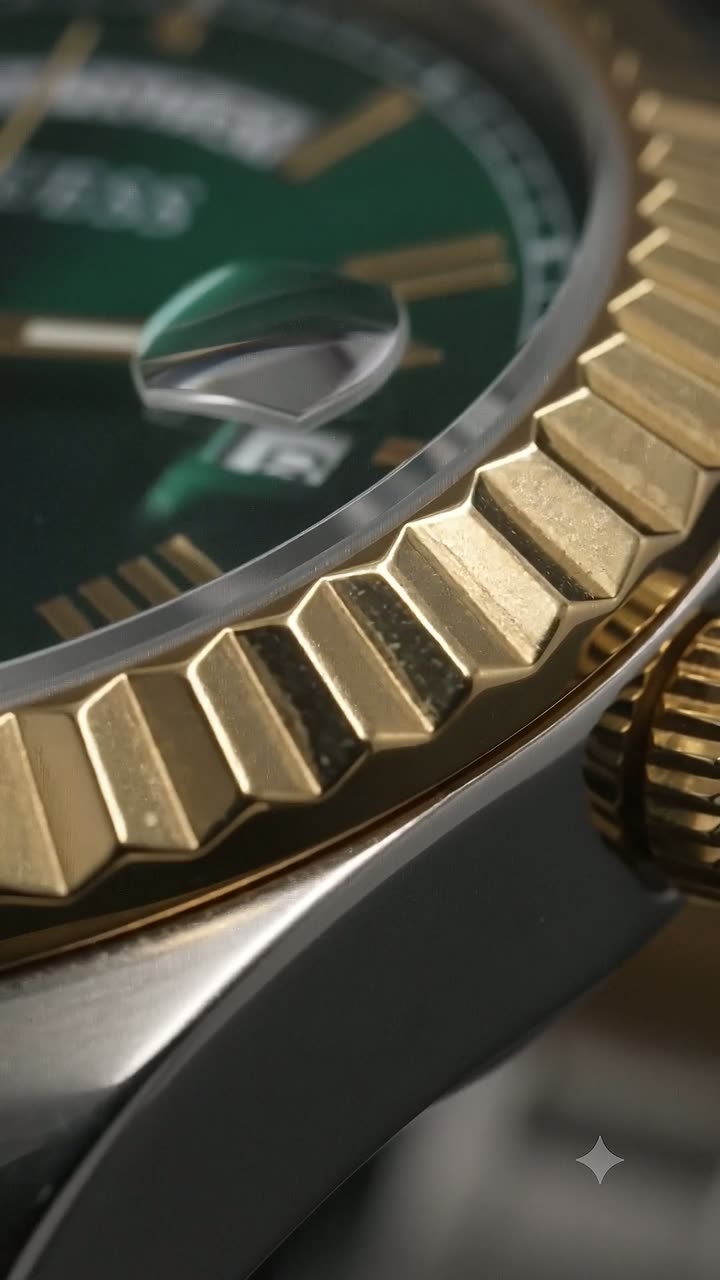
A journey does not come back. The watch film racks focus across the bezel, then the dial, then the date lens: it arrives somewhere. Its last frame is a close, settled detail and its first frame is a wide bezel, so the loop is a hard jump between two genuinely different images. Nothing is wrong with the film. It simply ends where it ends, and a repeat announces that.
Both are good films. They are good at different jobs, and the loop is the thing that tells them apart on a listing.
What to do about it
You do not direct the camera move — the move is part of what a fresh take decides, so it varies between attempts rather than being something you set. Which means this is not a brief you write. It is a choice you make once you have takes in front of you.
- Watch each take twice, not once. The first viewing tells you whether the film is good. Only the second one shows you the seam, because the seam does not exist until the film repeats.
- For a looping placement, prefer the take that returns. Turns, orbits and drifts that settle close to their start will cycle without announcing it. A take made from a single photo will not turn the product round, because that would show a side no photo shows — but a slow rock or a drift that settles back where it began loops just as cleanly.
- For a placement that plays once, prefer the take that arrives. A film that ends on a resolved detail is stronger where nothing is going to repeat it.
- Check the first and last frames side by side. If they are close in composition and light, it will loop. If one is wide and the other is tight, it will jump.
The same frame, doing two jobs
There is a tidy consequence here worth naming, because it joins up with the thing everyone already worries about.
The opening frame is the thumbnail — it is what a shopper sees before anything moves, and it is the frame that has to earn the press. On a looping surface that same frame is also the landing point of the seam. So the frame you chose for being arresting is the frame the film keeps cutting back to.
That is a happy accident when the film returns to it, because the strongest image in the film gets shown repeatedly. It is a jarring one when the film has travelled far away, because the strongest image arrives as an interruption.
The short version
A product video on a listing does not end. It restarts, and the restart is a cut you did not plan. Watch your takes twice before you choose one: a take that comes back to where it started will loop invisibly, and a take that arrives somewhere will announce itself every ten seconds. Both are useful. Pick the one that matches where the film is going to live.
Read enough? Watch your own product.
One photo in — a cinematic 10-second video and a full set of marketing photos out. Your first one is free.