Not every product earns a film
A catalogue arrives as a list, which makes it feel like a queue: start at the top, film everything, stop when the budget runs out. That is the most expensive order to work in. Products differ in how much a moving image can actually tell a buyer, and the ones that gain least are often sitting at the top of the list.
Published — written and checked by hand.
There is a moment, usually just after the first film comes back and it is good, when the plan becomes obvious: do this for everything. Work down the catalogue. It is a satisfying plan and it is the wrong one, because it treats a budget as something you spend evenly and a catalogue as something whose products all pose the same problem.
They do not. A film is a way of answering questions a still cannot answer, and different products leave different questions open. Some arrive at the listing with almost nothing left to explain. Spending the same amount on those as on the ones a buyer genuinely cannot picture is not fairness; it is just a worse allocation of the same money.
The question a film is actually answering
Before deciding anything, it is worth being precise about what motion adds, because the honest list is shorter than the enthusiasm suggests.
Motion shows how something behaves. How light travels across a surface as it turns. How a material moves — whether it is stiff or fluid, matte or liquid. How big it is relative to a hand or an ear. How a mechanism opens. How a texture reads when it is not held still for the camera.
That is the whole list, and every item on it is a property that a single frame flattens. If a buyer already knows all of those things about your product before they arrive, a film is decoration. Excellent decoration, possibly worth having — but it is not doing the job you are paying it to do.
So: how much is left to find out?
This is the test, and it is one question rather than a rubric. Standing at your own listing as somebody who has never seen the product: what do they still not know?
For a two-tone watch, the answer is a lot. A flat photograph cannot settle how the steel and the gold sit against each other as the wrist moves, whether the dial is the green it looks or a green that shifts, how deep the bezel actually is.
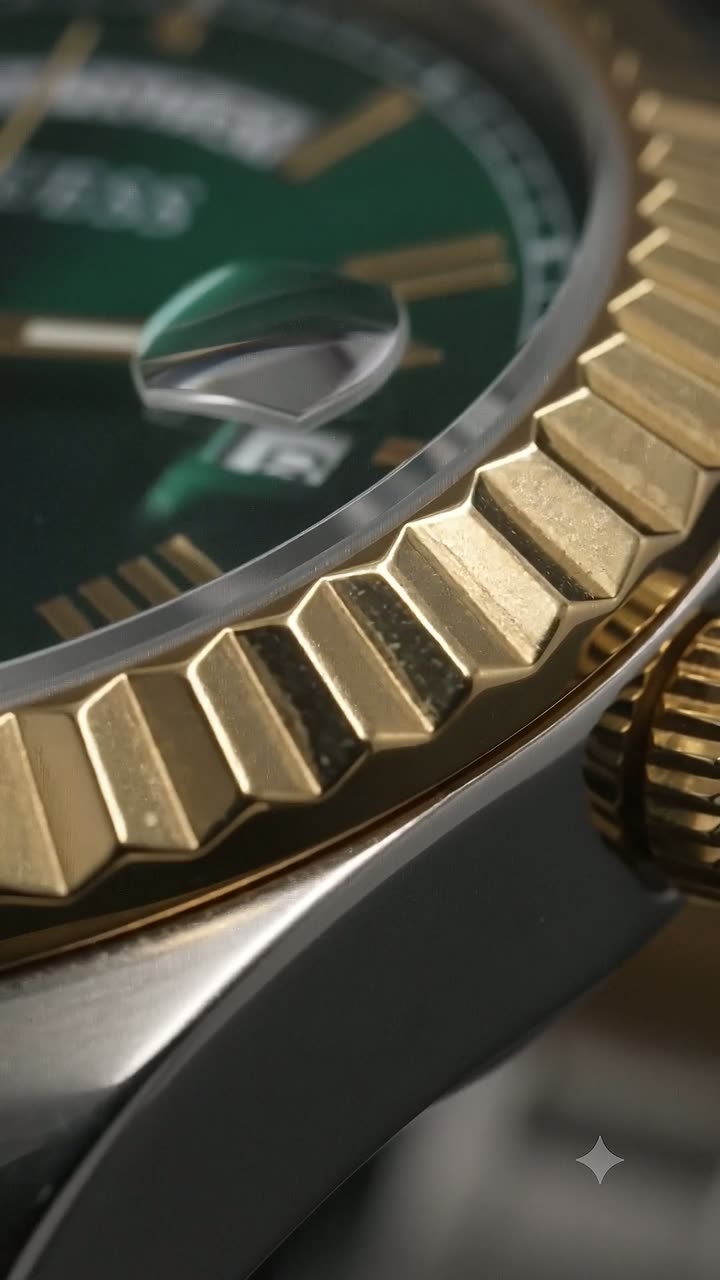
Ten seconds racking focus across the bezel, the dial and the date lens answers all three, and no still in any quantity does. That is a product where the film is load-bearing.
Now run the same test on a plain white cotton t-shirt in a size run. A buyer knows what a t-shirt does. They know how cotton moves. What they do not know is the exact shade of white, how heavy the fabric is, and whether the neckline is the shape they like — and those are still questions, answered better by a good macro of the knit and an on-model frame than by anything that moves.
A rough sort, and what each group should get
Most catalogues fall into three groups once you apply that test. The proportions vary wildly by what you sell, which is the point — they are your proportions, and reading them off your own products is most of the work.
- Products where motion is the argument. Anything whose appeal is in behaviour rather than appearance: jewellery and watches that live on how they catch light, fabrics and leathers that drape, cosmetics with texture or shine, food and drink where the pour or the crumble is the whole appetite. These earn a film and they earn a deliberate one — time spent choosing the mood, and a willingness to shoot a second take.
- Products where the questions are all static. Flat goods, standard formats, anything a buyer has held a hundred versions of. Books, plain apparel, most homeware, replacement parts. These need the still set — hero, macro, lifestyle, on-model — and the film adds very little a good macro does not.
- Products that should get nothing yet. The long tail that has not sold, the line you are about to discontinue, anything whose reference photo is old enough to show a version you no longer ship. Money spent here is spent twice: once on the render and once again when the product changes.
Spend the free preview where you are least certain
One practical consequence, because it is a genuinely one-shot resource. Your first film is a free watermarked preview of your own product, and there is exactly one of them per account — it is not a trial you can run across five products to see which works best.
So it should not go on the product you are most confident about. Confidence means you can already picture the result, which means the preview teaches you nothing you did not know. Spend it on the product you are genuinely unsure films well: the awkwardly-shaped one, the one whose colour you have never seen photographed properly, the material you cannot picture in motion. If it works there, you have learned something that transfers to the rest of the catalogue. If it does not, you found out for nothing.
Order matters more than totals
The other reason to sort before spending is that the first few shoots teach you things the later ones get for free.
Art direction is the obvious one — the mood you settle on for the first product is the mood the catalogue inherits, so it is worth settling it on a product you care about rather than on whichever item happened to be first alphabetically. But there is a quieter benefit. Shooting your three hardest products first tells you where the ceiling is. Shooting your three easiest first tells you nothing, and it tells you nothing after you have already spent the money.
Every attempt is a render and every render is charged, so this is not a theoretical ordering exercise. There is no free reroll. A catalogue worked through in a considered order costs the same as one worked through alphabetically and ends up in a better place, which is an unusually cheap improvement.
When the answer changes
This is a decision with a shelf life rather than a permanent filing. A product moves out of the third group the moment it starts selling. It moves into the first group if you reshoot it in a way that changes what it is — a new colourway, a redesign, a different material.
And a product can move down. A film shot against a reference photo of last season's packaging is answering questions about a product you no longer sell, which makes it worse than no film at all, because it is confidently wrong rather than merely absent.
The short version
Ask what a buyer still does not know when they arrive at each listing. Where the missing information is about behaviour — how it moves, catches light, drapes, opens, scales — a film is doing real work and is worth the money. Where the missing information is about detail, a still set answers it better and cheaper. Where nothing is missing, or where the reference photo is out of date, spend the money somewhere else. Then work in that order rather than in list order, hardest first.
Read enough? Watch your own product.
One photo in — a cinematic 10-second video and a full set of marketing photos out. Your first one is free.