The camera only turns onto a side you photographed
A product film can only turn the camera onto a side of the product that one of your photos shows, because any side it has not seen would have to be invented — a different label, a different colour. From one photo, the film holds that angle. Photographs of the back and the sides are what buy the turn, and they are cheap to take.
Published — written and checked by hand.
The shot most people picture when they imagine a product film is the turn: the product comes round, and you see the back. It is also the one shot a single photograph cannot honestly make.
The reason is simple once it is said out loud. A film made from your photo knows what your photo shows. It does not know what is on the back of the bottle, the far side of the bag or the case back of the watch, and if the camera goes round there it has to put something on that surface. It will look plausible. It will not be yours: a label you never printed, a seam in the wrong place, a colour borrowed from another product. And it arrives in the one beat you were going to put on your storefront.
What happens instead
Nitaris will not turn the camera onto a side none of your photos show. With one photo, the camera stays within about thirty degrees of the angle you shot. With photos of more sides, it can travel onto those sides and stops there. With all four, it can go the whole way round. The studio tells you which of those you have after it reads your photos, before you spend a credit.
None of this is a penalty for having one photo. A film that stays in front of the product still moves — it pushes in, pulls back, glides across the surface, lets focus travel from one detail to the next, or turns the set while the product holds still. That is most of what product-beauty film is made of anyway.
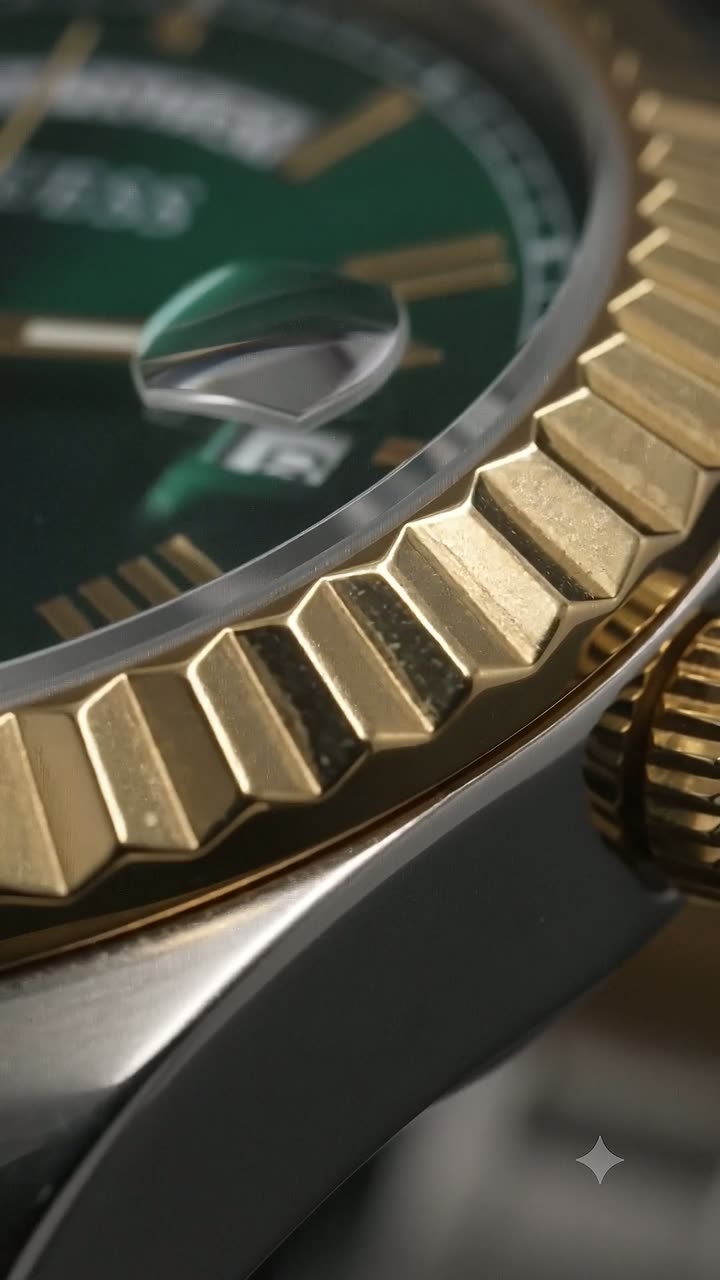
The watch above never turns. The focus travels from the bezel to the dial to the date, and it does not need the back of the case to be ten seconds of film.
What counts as a side
A turn goes round the product, through four faces: the front, the back, and the two sides. Those are the photos that widen it, and the rest are worth knowing about before you take anything.
- Four photos of the front are one side. A close-up, a crop or the same angle in different light adds detail. It does not add a side.
- The top and the base do not widen the turn. They matter to a shot that looks down onto a lid or tilts under a base, but a turn goes round, not over.
- A three-quarter view is not read as a side. It shows a corner, and a corner does not say enough about the middle of the next face. Take each side square-on.
- Another colourway is not another side. If your listing shows the bag in black, red and tan, the red photo says nothing about the back of the black bag, and Nitaris ignores it rather than borrowing its colour.
- Packaging, size charts and infographics are not the product, and are ignored for the same reason.
A side counts when it can be described
Before the camera turns onto a side, that side has to be put into words: its colour, its finish, and any text on it, exactly as printed. That is how the film knows what to show when it gets there. So a photo of the back is only useful if it lets someone say those things. Blurred, dark, cropped off halfway or shot at an angle that turns the label into a smear, it documents nothing, and that side stays out of reach.
The test is the one you would use on a stranger's photo. Could you describe the back of this product from this picture alone, well enough for someone to draw it? If you could, so can the shoot.
How to take them in a minute
- Turn the product, not the camera. Put it on the same spot, shoot the front, then rotate it a quarter turn at a time and shoot each face from where you stood.
- Keep the whole face in frame, square-on, with any text sharp and the right way up.
- Use the light you already have if it is even. The extra photos do not need to be beautiful or to match each other. They are there to describe the object, not to be seen.
- On the web, upload them together with the front, in the same shoot. A shoot takes up to five photos, which is room for all four sides and a detail.
- On Shopify, look at the product's own photos. The app reads up to three more of them behind the featured image, so a listing that already shows the back and a side gives the film its turn with nothing extra to upload.
When the turn is not worth it
A turn is worth exactly what is on the other side. That is the question to ask before taking a single extra photo, and for plenty of products the honest answer is: not much.
A plain ring, a drinking glass or a ball looks the same from behind, so the turn shows nothing the front had not. A picture frame's back or the inside of a phone case is the part a buyer will never judge the product by. For products like these, a film that holds the front and spends its ten seconds on the surface is not the lesser film. It is the better one.
The turn earns its place when the back carries something a buyer wants to check: the case back of a watch, the ingredient panel on a bottle, the pocket on the back of a bag, the print on the back of a shirt. If your product has a side like that, it is worth the minute it takes to photograph.
The short version
A film can only show a side of your product that a photo has shown it. From one photo, it stays in front of the product and moves in other ways. Photograph the back and the sides square-on, sharply and in the same colourway, and the camera can turn onto them. Before you do, ask what is on the back. If the answer is nothing a buyer would look for, the front is the film.
Read enough? Watch your own product.
One photo in — a cinematic 10-second video and a full set of marketing photos out. Your first one is free.