Your colourways do not each need a film
A product sold in four finishes is not four products, and it does not need four films. The film sells the object — its shape, its scale, the way light travels over it — and those are identical across colourways. What has to be repeated per variant is the still set, because choosing between finishes is a comparison, and a comparison needs matching frames.
Published — written and checked by hand.
If you sell one ring in gold, rose gold and silver, you have a decision to make before you generate anything, and most sellers make it by default: shoot everything three times. It feels like the safe answer. It is usually the wrong one, and the reason is that the two things you get back are not doing the same job.
The film sells the object, the stills sell the choice
A ten-second film answers questions about the thing: what shape is it, how big is it, how does its surface behave when light moves across it, is it as good as the photograph implied. Every one of those answers is the same for the gold version and the silver version, because they are the same object with a different plating on it.
The stills answer a different question, and it is the only question a variant picker exists to ask: which of these do I want. That is a comparison, and a shopper cannot make it from a description. They need to see the actual finish — rose gold against skin is a genuinely different proposition from yellow gold against skin, and no amount of naming it in the copy does the work of showing it.
So the split is not arbitrary. One film, stills per variant. The film earns its keep once and keeps earning it on every variant page; the still set is the thing that has to be repeated, and it is the cheaper half to repeat.
A comparison needs matching frames
There is a second reason to shoot the variants as stills rather than as separate films, and it matters more than the cost does.
A comparison is only readable if everything except the compared property is held still. If your gold ring is photographed on white in soft light and your rose gold ring is on slate under a hard key, the shopper cannot tell how much of the difference is the metal and how much is the lighting. You have given them two nice images and taken away the one thing they came for.
Stills generated as a set from the same art direction hold that constant by construction — same framing, same light, same distance, one variable changed. Two separately directed films almost never do, because a film has a camera move and a grade in it, and both of those are choices that will differ.
Which variant to put in the film
If only one finish gets a film, pick deliberately rather than picking your favourite.
- The one you sell most of. The film will run on the collection page, in the feed and in ads, where it is doing acquisition rather than variant selection. It should show the version most buyers end up with.
- Or the one that moves best. If one finish is markedly more reflective — polished steel against brushed, gloss against matte — that is where ten seconds of moving light earns the most, and the gain is visible in a way it is not in a still.
- Not the rarest or the dearest one, unless it is also one of the two above. A film of the limited edition sets an expectation the default variant then has to survive.
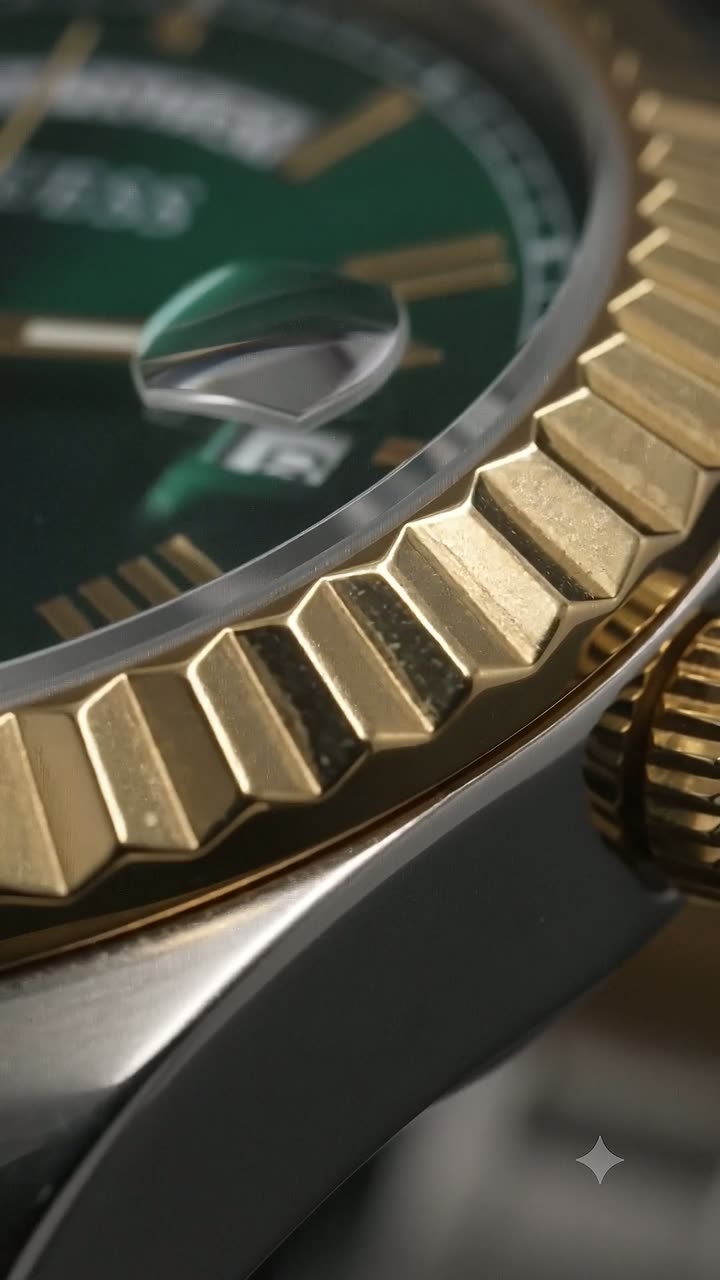
The watch film on this site is a useful case, because it is literally a two-tone piece — steel and gold in the same object, racking focus across a fluted bezel and a green dial. A shop selling that watch in all-steel and in two-tone has one film's worth of motion and two finishes' worth of stills, and the film below is doing the first job while saying nothing about the second.
When a variant does deserve its own film
The rule has real exceptions and they are worth naming, because applying it blindly is how you under-shoot the one product it did not fit.
The first is when the finish is the argument. An iridescent or colour-shifting surface, an oil-slick glaze, anything whose whole appeal is that it changes as you move around it — that property is invisible in a still by definition, so a still set cannot carry it and the variant needs the motion.
The second is when the finishes sit in different tiers. A steel version and a solid gold version of the same piece are not a colourway, they are two products at two prices, and the set each one is shot in should agree with its own price rather than borrowing the other's. That is a positioning decision before it is a production one.
The third is when the variants differ in more than colour — a different strap, a different closure, a different size. Once the silhouette changes, the film's answers stop being shared and the argument for reusing it goes away.
The thing not to do
One shortcut is worth ruling out explicitly, because it is available and it is tempting: do not take the gold film into an editor, shift the hue, and publish it as the silver one.
It will look plausible. It will also be wrong in the specific way that costs a return rather than a sale, because a recoloured metal does not reflect like the metal it is pretending to be — the highlights sit where the original put them and carry the wrong warmth, and a buyer who has handled real silver reads it as off without necessarily being able to say why. A film is a claim about what will arrive in the parcel, and this is a claim you cannot keep.
Regenerating from the variant's own reference photo is the honest version of the same instinct. That is a genuine shoot of a genuine finish, which a hue shift is not.
Where this leaves the budget
Worked through, a product with four finishes usually comes to one film and four still sets rather than four of each. That is not a corner cut — it is the shape the shopper's questions actually have, and the frames you skipped were the ones repeating an answer the film already gave.
And the money it frees is better spent along the catalogue than across the variants. A second product with its own film does more for a storefront than a fourth film of a ring you have already shown moving, because the shopper deciding between your gold and your rose gold is already on your site, and the one who has never seen either is not.
Read enough? Watch your own product.
One photo in — a cinematic 10-second video and a full set of marketing photos out. Your first one is free.